
7 Unforgettable Camel Ride in Merzouga Experiences in the Sahara
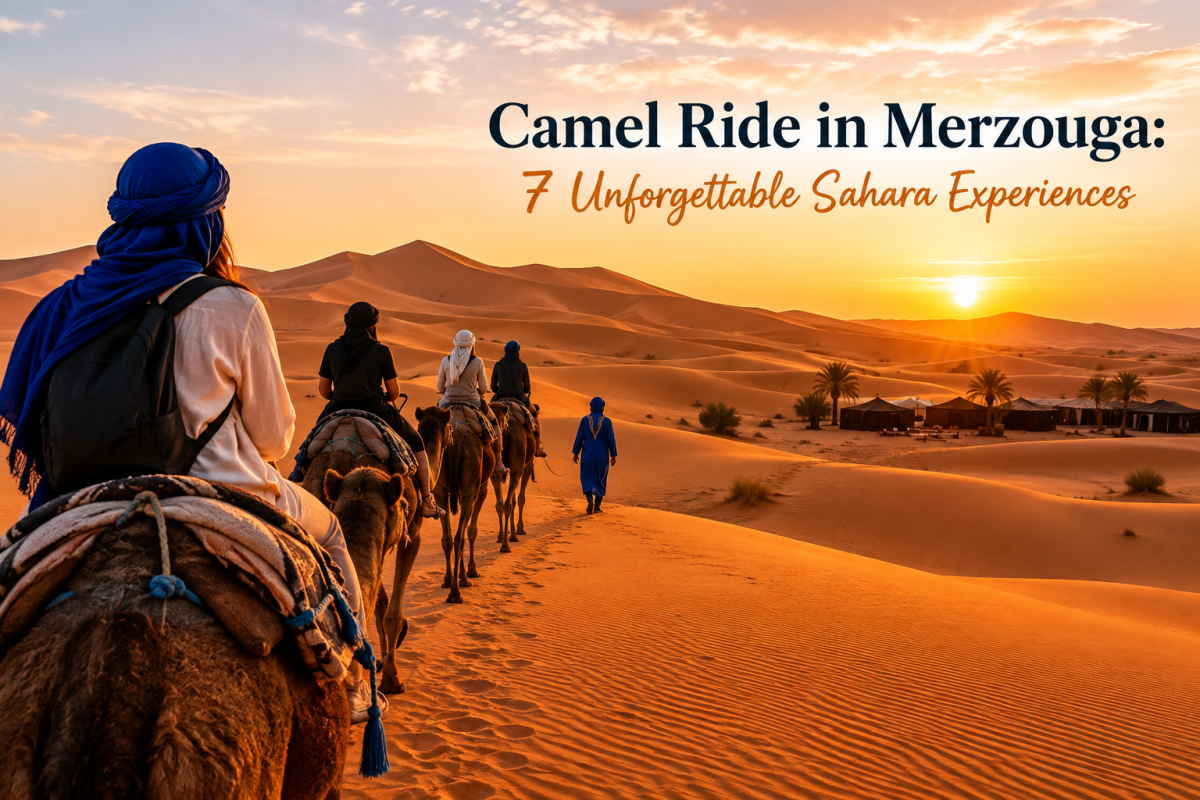
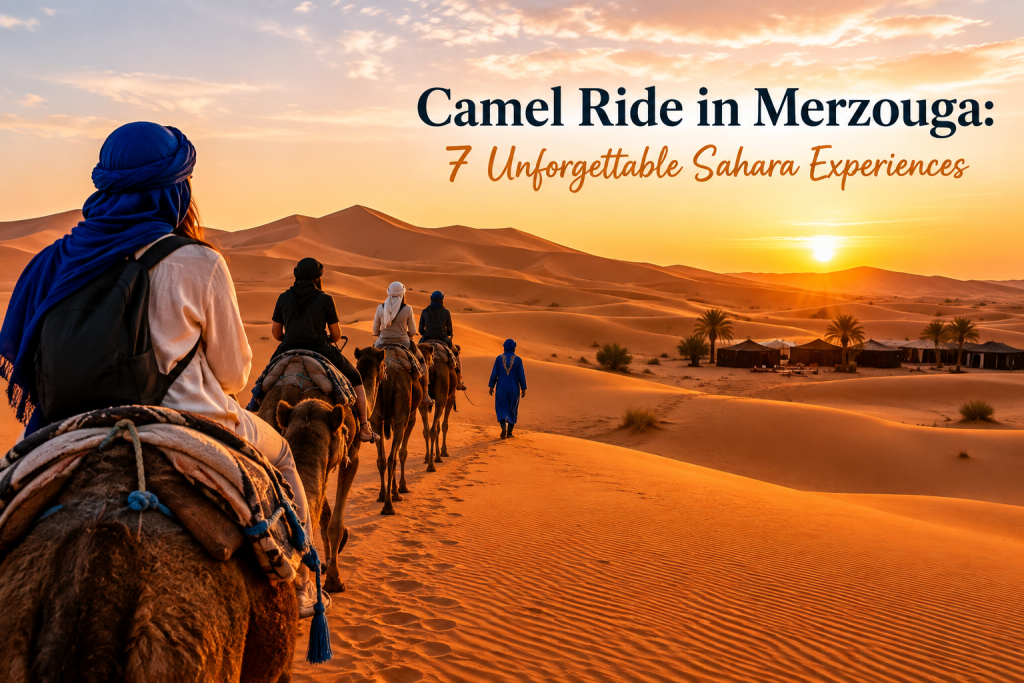
A camel ride in Merzouga is one of the most memorable ways to experience Morocco’s Sahara. On the edge of Erg Chebbi, camel caravans leave the village and nearby desert lodges for golden dunes, sunset viewpoints, traditional camps, and quiet stretches of sand that feel far removed from Morocco’s cities.
Whether you have a few hours or want to spend a night in the desert, Merzouga offers camel experiences for couples, families, solo travelers, photographers, and private groups. This guide covers seven worthwhile ways to experience the dunes, along with the best time to visit, what to wear, safety considerations, desert camping, routes from Marrakech and Fes, and practical planning advice.
Why Choose Merzouga for Camel Trekking?
Merzouga is a small settlement in southeastern Morocco beside the dunes of Erg Chebbi. These large wind-shaped dunes are known for colors that shift from pale gold to orange and deep amber as the light changes throughout the day.
Unlike a quick roadside desert stop, camel trekking lets you move slowly into the dunes. The pace gives you time to appreciate the scale of the landscape, photograph the changing sand formations, and experience quieter areas away from roads and vehicles.
Merzouga is also particularly well suited to an overnight experience. Camel rides can be combined with dinner, Moroccan tea, local music, stargazing, sunrise, and accommodation in traditional or more comfortable luxury-style desert camps.
7 Memorable Camel Ride in Merzouga Experiences
1. Ride into Erg Chebbi at Sunset
Sunset is one of the most popular times for camel trekking in Merzouga. As the sun drops, lower-angle light brings out the curves and shadows of Erg Chebbi, while the sand often takes on warmer orange and red tones.
A typical short excursion may involve roughly one to two hours on the camel, although exact timing depends on the experience and route. Guides often stop at a suitable dune so guests can walk up the sand, take photographs, and watch the sunset before continuing to camp or returning to their starting point.
2. Watch the Sahara Sunrise
Sunrise offers a different atmosphere. The desert is generally cooler, the dunes are softly lit, and early morning can be especially peaceful. Travelers staying overnight can often walk to a nearby dune for sunrise before breakfast and their return journey.
Photographers may prefer this time because the low light emphasizes ridges, textures, and long shadows without the harsher contrast of midday sun.
3. Spend a Night at a Desert Camp
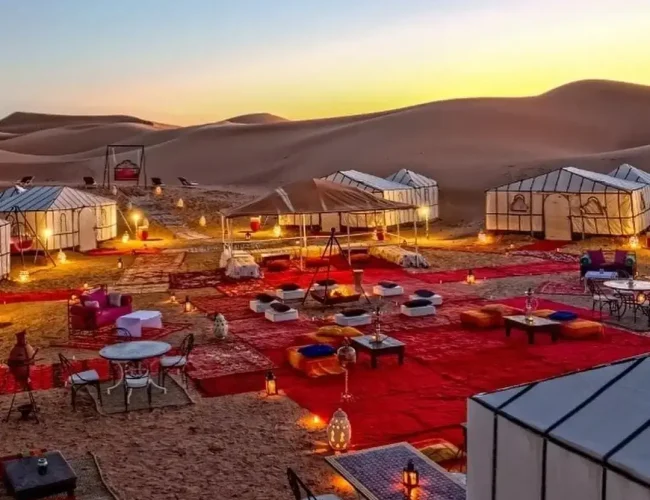
For many visitors, the most complete Merzouga experience combines camel trekking with an overnight camp. After crossing the dunes, travelers settle into camp, have dinner, and spend the evening beneath the desert sky.
Camp styles vary substantially. Traditional-style camps emphasize simplicity and atmosphere, while luxury camps may offer larger beds, electricity, private bathrooms, hot water, and more elaborate interiors. Facilities should always be confirmed with the operator before booking rather than assumed from the term “luxury.”
4. Experience Dinner and Music in the Sahara
A desert overnight is also an opportunity to enjoy Moroccan hospitality. Depending on the camp, dinner may include salads, tagine, couscous, bread, and tea. Evenings are often accompanied by local music around the camp area.
Merzouga’s location away from major urban centers can also provide impressive night skies. On a clear night, simply sitting outside after dinner can be as memorable as the camel trek itself.
5. Meet Local Guides and Learn About Desert Culture
A good local guide contributes much more than navigation. Guides can explain the desert environment, share information about regional traditions, and help guests understand the communities surrounding Merzouga. Depending on your wider itinerary, you may encounter Amazigh (Berber) traditions, music, textiles, tea customs, and stories about everyday life in southeastern Morocco.
Cultural experiences are most rewarding when they are approached respectfully rather than treated as staged attractions. Supporting locally operated camps, guides, drivers, restaurants, and craftspeople can also help keep tourism spending within communities in the region.
6. Combine Camel Trekking with Dune Photography
Erg Chebbi is especially photogenic around sunrise and sunset. Wide-angle compositions can convey the scale of the dunes, while silhouettes of camels and riders work well against the evening sky. Higher dune viewpoints can reveal repeating ridgelines and patterns that are difficult to see from lower ground.
Protect cameras and phones from blowing sand, keep equipment zipped away when it is not in use, and bring spare power if you are staying overnight. Your guide can often suggest a good stopping point without requiring you to cross fragile or difficult terrain unnecessarily.
7. Add Other Merzouga Desert Activities
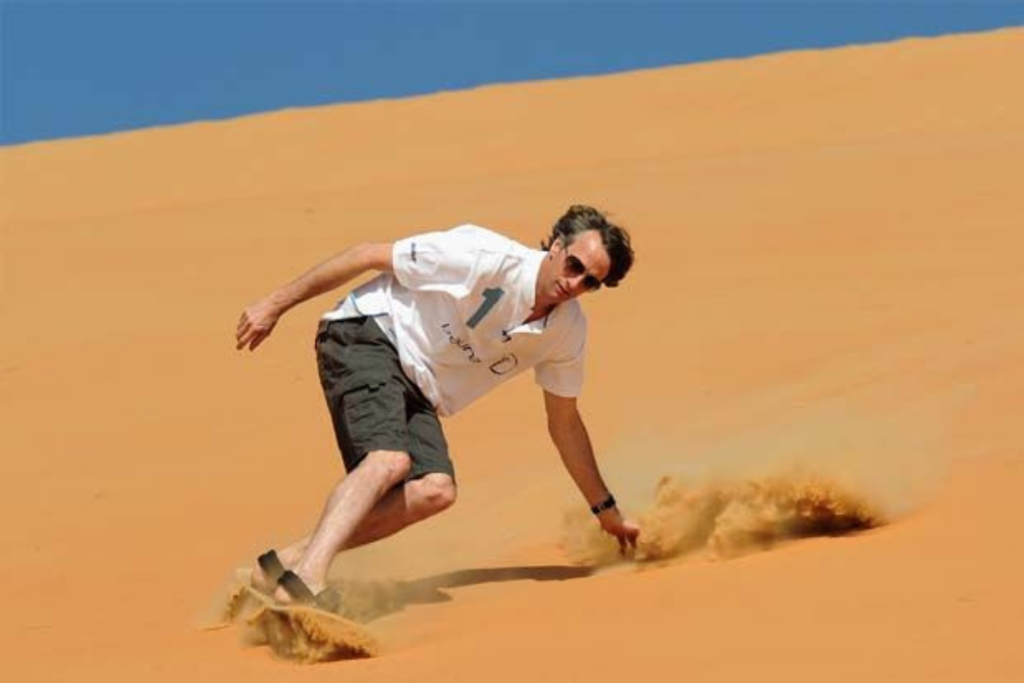
Camel trekking is a traditional, slow-paced way to experience Erg Chebbi, but it can be combined with other activities. Quad excursions are available around Merzouga for travelers looking for a faster experience, while walking on the dunes provides time for photography and quiet views.
Travelers already staying around Erfoud can also consider a Day Trip from Erfoud to Merzouga Desert. Whatever activity you choose, use designated routes and follow local guidance to reduce unnecessary disturbance to the desert environment.
What to Expect During a Camel Ride in Merzouga
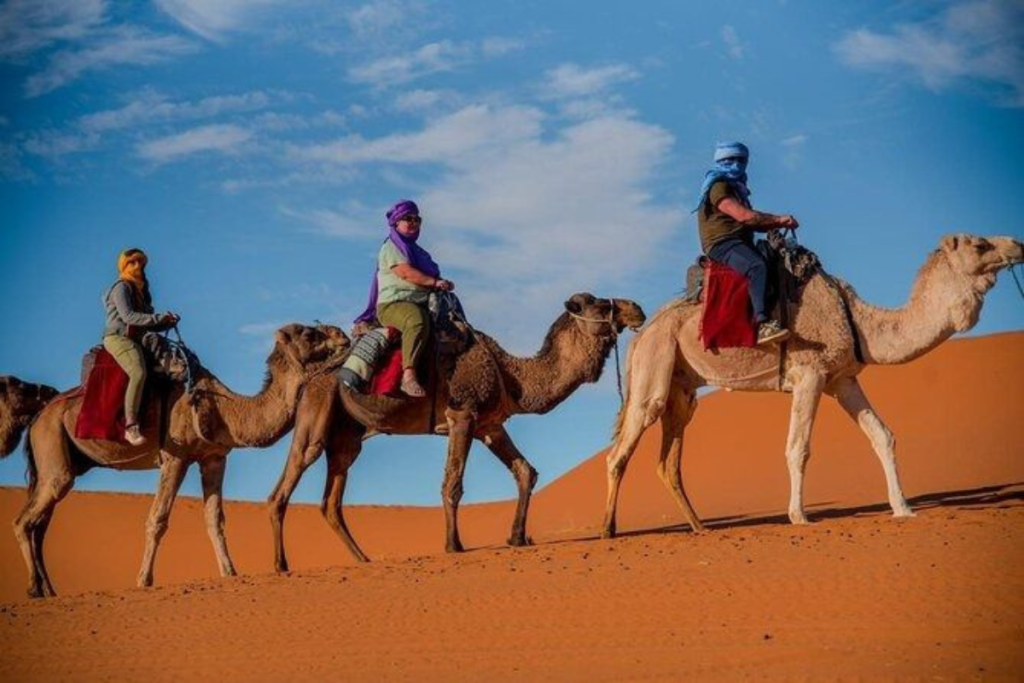
Before departure, your guide should explain how to mount, sit, hold on, and dismount. The camel’s rising and kneeling movements can feel unusual because its front and back legs do not move into position simultaneously. Follow the handler’s instructions and remain seated until you are told it is safe to get on or off.
Once underway, camel caravans move at a measured pace. Short rides are commonly designed around sunset or sunrise, while overnight excursions use the camel journey as transportation between the edge of the dunes and camp. Longer treks may also be available for travelers seeking more time in the desert.
If you have back, hip, knee, balance, mobility, or other health concerns, discuss them with the operator before booking. Camel riding may not be appropriate or comfortable for everyone, and an alternative transfer to camp may sometimes be a better option.
How Long Does Camel Trekking in Merzouga Last?
The duration depends on the package. A short camel experience is often around one to two hours, while sunset and sunrise rides are timed around the available daylight. An overnight trek normally combines riding with a night at camp and a return the following morning.
Longer desert expeditions can provide a slower experience away from the main village, but travelers should compare the actual amount of riding, accommodation, meals, transfers, and included activities before booking. Tour names do not always describe precisely how much time is spent on a camel.
Best Time for a Camel Ride in Merzouga
Spring and autumn are generally among the most comfortable seasons for outdoor activities in Merzouga. March to May and September to November typically avoid the most intense summer heat, making camel trekking, dune walks, and evenings outside easier to enjoy.
Summer can become extremely hot during the day, so activities are often better timed for early morning or late afternoon. Follow local advice about heat and hydration. Winter can be pleasant in daylight, but temperatures can fall sharply after sunset, making warm layers important for an overnight stay.
Merzouga Weather and What to Wear
The desert’s dry conditions and temperature changes between day and night make flexible clothing useful. Lightweight, loose-fitting garments can help protect your skin from direct sunlight, while a warmer layer is valuable after sunset.
A practical packing list for camel trekking includes:
- Lightweight, breathable clothing and comfortable trousers
- A warm jacket, fleece, or similar layer for cool nights
- Comfortable closed-toe walking shoes
- A scarf or bandana for sun, wind, and blowing sand
- High-SPF sunscreen and UV-protection sunglasses
- A hat with good sun coverage
- A refillable water bottle
- Personal medication and a small first-aid kit
- A portable charger for overnight stays
- Travel-sized toiletries
- A camera or smartphone, protected from sand
Pack lightly if your luggage is being carried to a camp. Ask your operator whether larger suitcases remain at a hotel or transfer point and what type of overnight bag is recommended.
Camel Riding Safety and Comfort Tips
Choose an experienced operator and listen carefully to the handler before mounting. Wear clothing that lets you move comfortably, secure loose belongings, and tell your guide immediately if your saddle feels unstable or you are experiencing pain.
Hydration and sun protection are particularly important. Carry adequate water, use sunscreen, and avoid unnecessary exposure during the hottest part of the day. Weather can change, including periods of stronger wind and blowing sand, so local guidance should take priority over a fixed sightseeing schedule.
Responsible animal tourism matters as well. Look for camels that appear appropriately cared for and handlers who treat them calmly. Avoid encouraging operators to overload animals or push an animal that appears injured or distressed.
Traditional Desert Camping vs. Luxury Glamping
Traditional-style desert camps generally suit travelers looking for a simpler stay and a strong emphasis on atmosphere. Luxury glamping is intended for those who want more privacy and comfort after a day of sightseeing.
Neither category is automatically better. Before reserving, check the sleeping arrangements, bathroom type, meals, electricity, hot-water availability, luggage transfer, camel trek duration, and whether the camp is actually located in or beside the dune area. These details are more useful than relying on accommodation labels alone.
How to Get to Merzouga from Marrakech
Merzouga is far enough from Marrakech that it should be treated as a multi-day journey rather than a day trip. Most road itineraries cross the High Atlas region and continue through southeastern Morocco, making the scenery and historical stops part of the experience.
Marrakech Desert Tours can combine transport, accommodation, sightseeing, and the Merzouga desert experience. A popular choice is a 3-Day Tour From Marrakech to Merzouga, while travelers wanting a less compressed journey can choose longer routes.
Highlights on the Marrakech to Merzouga Route
The road east from Marrakech crosses mountain landscapes and traditional settlements before reaching the drier valleys of southern Morocco. Ait Ben Haddou is one of the best-known stops. The fortified settlement is a UNESCO World Heritage Site and is also familiar to many visitors from film and television productions.
Nearby Ouarzazate is closely associated with Morocco’s film industry. Farther along, itineraries may include valley landscapes, Tinghir, and Todra Gorge before continuing toward Merzouga. Travelers wanting to visit Ait Ben Haddou without continuing to the Sahara can instead consider a Day Trip from Marrakech to Ait Ben Haddou and Ouarzazate.
For additional time between the desert and northern Morocco, a 5 Days Tour From Marrakech to Fes provides a slower alternative, while a 4 Days Tour From Marrakech to Fes can suit travelers with a tighter itinerary. Travelers planning an extended circuit can also compare a 6 Days Tour From Marrakech.
Traveling Between Fes, Merzouga, and Marrakech
Merzouga works naturally as a stop between Fes and Marrakech, allowing travelers to enter the Sahara without returning to their departure city. A 3 Days Tour From Fes To Marrakech is a relatively compact option, while the existing Fes to Marrakech desert tour in 3 days provides another itinerary to compare.
Travelers who prefer additional time can consider a 4 Days Morocco Desert Tour From Fes, a Fes to Marrakech Desert Tour 5 Days, or a 7 Days Tour From Fes. The broader selection of Fes Desert Tours is useful when Merzouga is one part of a longer route.
If you have an extra day in Fes before heading south, a Day Trip from Fes to Chefchaouen can add northern Morocco to the journey. Official destination information for Fes is also useful when planning time in the city itself.
Longer Morocco Itineraries with Merzouga
Travelers arriving through Casablanca can build Merzouga into a broad circuit rather than making the desert a standalone trip. A 10 Days Tour From Casablanca Morocco can connect major cities, mountain scenery, and the Sahara, while Casablanca Desert Tours provide additional desert-focused options.
If you want to start with city sightseeing, compare Tours From Casablanca. Travelers with a free day in the city can also use a Day Trip from Casablanca to Marrakech when it fits their wider travel plan. Official tourism information for Casablanca can help with destination planning.
For travelers with nearly two weeks, longer circuits reduce the need to rush between destinations. A Morocco Itinerary 12 Days, Morocco Itinerary 13 Days, or Morocco Itinerary 14 Days can provide more space for Morocco’s imperial cities, Atlas landscapes, and Sahara experiences.
Visiting Merzouga from Tangier and Northern Morocco
A journey from Tangier to Merzouga is best incorporated into a longer Morocco route because there is much to see between the north and southeast. Depending on available time, an itinerary can connect Tangier, Chefchaouen, Fes, Merzouga, and Marrakech.
Travelers can compare Tangier Tours with the wider collection of Tours From Tangier. Specific options include a 7 Days Tour From Tangier and a more leisurely 10 Days Tour From Tangier. The Moroccan tourism office’s information about Tangier can help when planning time in the city.
Private Tours, Group Trips, and Choosing an Itinerary
The right format depends on budget, schedule, and travel style. Private tours provide more control over departure times, sightseeing stops, accommodation, and the pace of travel. That flexibility can be particularly useful for couples, families, photographers, and small groups.
Group trips can be practical for travelers who want to reduce costs and meet other visitors, but they normally involve a more fixed schedule. In either case, compare driving time carefully. A route that includes numerous attractions on paper may allow little time at each stop.
From Marrakech, the complete range of Tours From Marrakech includes both desert and wider Morocco itineraries. Longer options include an 8 Days Tour From Marrakech, 10 Days Tour From Marrakech, 12 Days Tour From Marrakech, 14 Days Tour From Marrakech, and 15 Days Tour From Marrakech.
Travelers beginning elsewhere can compare dedicated Tours From Fes and other city-based departures. Choosing a starting city that matches your arrival airport and final destination can prevent unnecessary backtracking.
What If You Do Not Have Time to Reach Merzouga?
Not every itinerary has enough time for the Sahara. From Marrakech, Day Trips from Marrakech can take visitors to places such as the Atlas region and other nearby landscapes. Essaouira offers a very different coastal experience, accessible on a Day Trip from Marrakech to Essaouira.
Agafay, closer to Marrakech, is another option for travelers looking for a desert-style landscape without making the long journey to southeastern Morocco. It is important, however, not to confuse Agafay with the Sahara: travelers specifically seeking towering golden sand dunes should allow sufficient time to reach Merzouga and Erg Chebbi.
For general trip planning and destination information, Morocco’s tourism office also provides information about Marrakech.
Responsible Tourism in the Merzouga Desert
The Sahara is both a natural environment and home to local communities. Carry waste out of the dunes, reduce single-use plastics where practical, follow marked or locally recommended routes, and avoid disturbing wildlife or vegetation.
When choosing a camel excursion, consider animal welfare alongside price and convenience. Responsible handlers should provide suitable care, avoid excessive loads, and not force animals that appear injured or unwell to work.
Local spending is another important consideration. Using locally based guides, camps, restaurants, and artisans helps keep more of the economic benefit of tourism within the destination. Respectful interaction also means asking permission before taking close-up photographs of people.
Photography Tips for Erg Chebbi
Sunrise and sunset offer the most dramatic natural light, but good desert photography is not only about color. Look for repeating dune ridges, footprints, caravan silhouettes, and the contrast between illuminated slopes and shaded sand.
Sand can damage cameras and lenses, so avoid changing lenses in windy conditions when possible. Keep spare batteries and memory cards protected inside a closed bag. If using a phone, a portable charger is useful on an overnight trip where charging facilities may be limited.

Combining the Sahara with the Atlas Mountains
One of the strengths of a Moroccan road trip is the rapid change in scenery. A journey can move from Marrakech’s urban landscape into the High Atlas and then continue through rocky valleys toward the Sahara. The contrast makes the overland journey to Merzouga part of the experience rather than simply a transfer.
When comparing routes, prioritize enough time for stops and rest. Longer journeys can include mountain villages, historic architecture, valleys, Fes, and the desert without requiring every day to be dominated by driving.
Planning and Booking Your Merzouga Camel Experience
Before booking, check exactly what is included. Confirm the camel-riding duration, camp type, meals, transfers, room or tent facilities, luggage arrangements, group size, and whether sunrise or sunset activities are part of the itinerary.
Also consider your arrival and departure cities. A circular Marrakech itinerary works for some travelers, while others save time by traveling from Marrakech through Merzouga and finishing in Fes, or taking the route in reverse. Planning To Morocco can structure a route around the destinations, accommodation style, and activities that matter most to your trip.
Frequently Asked Questions About Camel Rides in Merzouga
How long does a camel ride in Merzouga last?
Short camel rides commonly last around one to two hours, although the actual duration depends on the package and route. Sunset, sunrise, overnight, and longer trekking experiences are also available.
Do I need camel-riding experience?
No previous experience is normally required. Your handler should explain how to mount, sit, and dismount before the trek. Tell your guide if you are uncomfortable at any stage.
Is camel trekking in Merzouga suitable for everyone?
Not necessarily. The mounting movement and riding position can be uncomfortable for people with certain back, hip, knee, mobility, balance, or other health concerns. Contact the operator before booking if you are unsure whether camel riding is appropriate for you.
What is the best time of year for Merzouga?
Spring and autumn, particularly March to May and September to November, generally provide more comfortable conditions for desert activities. Summer days can be extremely hot, while winter nights can become cold.
What should I wear for camel trekking?
Choose lightweight, breathable clothing, comfortable trousers, closed-toe shoes, sunglasses, sunscreen, and a hat or scarf. Bring a warm layer if you will be in the desert after sunset or overnight.
Can I stay overnight in the Sahara?
Yes. An overnight desert camp is one of Merzouga’s most popular experiences. Accommodation ranges from simpler traditional-style camps to glamping options with additional facilities. Confirm exactly what your chosen camp provides before booking.
Can I combine camel trekking with quad biking?
Yes. Many travelers combine a slow camel trek with other Merzouga activities such as quad riding, dune walking, photography, and cultural experiences. Follow designated routes and operator safety instructions.
Is Merzouga a day trip from Marrakech?
No. The journey is too substantial for Merzouga to be a sensible Marrakech day trip. A multi-day itinerary allows time for the High Atlas, southeastern Morocco, and the Sahara without attempting an impractical same-day return.
Can I travel from Marrakech to Fes via Merzouga?
Yes. This is a popular way to incorporate the Sahara into an overland Morocco itinerary while avoiding a return to the original departure city. Several three-, four-, and five-day routes connect Marrakech, Merzouga, and Fes.
Where can I find official information about Merzouga?
In addition to checking details with your tour operator, Morocco’s official tourism website provides destination information for the Errachidia, Midelt, and Merzouga region.
Is a Camel Ride in Merzouga Worth It?
For travelers who want to experience Morocco’s large Sahara dunes, Merzouga is one of the country’s standout destinations. A short camel trek provides the scenery and atmosphere of Erg Chebbi, while an overnight excursion adds sunset, dinner, stargazing, camp life, and sunrise to the experience.
The best trip is not necessarily the itinerary that covers the most places. Give yourself enough time for the journey, choose a camp and camel operator carefully, pack for both daytime sun and cooler nights, and treat the desert and its communities with respect. With thoughtful planning, camel trekking in Merzouga can become a memorable centerpiece of a wider Morocco journey.